
The Legal Crux of the Kappa Kappa Gamma Lawsuit Appeal
Can an Organization’s Board Make Key Changes Affecting the Organization without Membership Approval?
In September 2026, Wegman Hessler litigation attorneys appeared before the U.S. Court of Appeals for the Tenth Circuit, presenting oral arguments in the well-publicized case, Holtmeier v. Kappa Kappa Gamma Fraternity. The Wegman Hessler team represents the three members of Kappa Kappa Gamma’s University of Wyoming chapter who are appealing the dismissal of their lawsuit. The suit challenges Kappa leadership council’s decision, without membership vote, to expand the organization’s historical definition of a woman (assumed to be female-at-birth) to now include individuals who identify as women. Angela Lavin, Wegman Hessler litigation practice lead, argued the case, supported by litigation attorneys Jay Carson and Sharon Ross.
The court heard arguments but has not yet ruled.
This case has been covered nationally, mostly as part of a larger debate regarding transgender issues. Yet the greater question the court now must address is more practical than political as it relates to board actions and nonprofit law. At the heart of the matter is this: Can a nonprofit board make decisions that effectively alter the organization’s governing documents without presenting them to the membership for approval.
In comments made to the media on the steps of the courthouse after the argument, Lavin said, “This case is not about politics or personal identity. It is about whether organizations established as ‘women’s organizations’ can fundamentally change who they serve without transparency, accountability or the consent of the women who belong to them.”
The backstory on the case
Kappa Kappa Gamma (aka “Kappa”) was founded in 1870. It is an international fraternal organization (i.e., a college sorority) that was incorporated in the state of Ohio as a nonprofit. Although the case was filed in federal court in Wyoming and argued in Colorado, Ohio law governs it.
Kappa’s Articles of Incorporation state that its purpose is “to unite women, through membership, in a close bond of friendship.” Its Bylaws state that a “new member shall be a woman.” Neither document defines the word “woman.” The appellants argue that it never needed defining. They contend that for more than 150 years, Kappa members and the organization itself understood “woman” to mean a biological woman, female at birth.
The Bylaws also state how the governing rules can be amended and changed. An amendment requires a two-thirds vote at a Convention, and the exact text must be sent to voting members three months before the meeting where votes on the proposed bylaws change would be cast.
According to the complaint, that process was not followed.
Instead, in a position statement posted to Kappa’s online member portal, Fraternity Council described the organization as “a single-gender organization comprised of women and individuals who identify as women.” A 2022 FAQ issued before that year’s Convention repeated the same language. Neither were presented to the membership for approval.
In the fall of 2022, the Kappa Kappa Gamma chapter at the University of Wyoming accepted a transgender student – a biological male – student to membership. Members objected, and asked the Fraternity to enforce the bylaws. When it refused to do so, six members initiated a lawsuit in the Wyoming District Court.
The federal court in Wyoming dismissed the case in 2023. After an earlier appeal and an amended complaint, it dismissed the case again in August 2025, this time with prejudice.
The current argument before the U.S. Court of Appeals for the Tenth Circuit followed.
Interpreting a definition versus adding to it
Both sides agree that Kappa’s current rules give its board, the Fraternity Council, the power to interpret the Bylaws. The disagreement is over whether the Board’s conduct is more than a mere interpretation of an undefined term.
Kappa’s view, which the district court accepted, is that “woman” is undefined, so the Council gave it a reasonable meaning; Ohio courts do not second-guess a private organization’s reasonable reading of its own rules.
The view of those seeking an appeal is that the Fraternity Council did not “interpret” the term woman but instead added a new group of people to the membership.
Lavin made the point directly to the panel: “There is nothing to suggest that the term ‘woman’ was vague or ambiguous. There was no method and no disclosure by Kappa’s Fraternity Council indicating that the term ‘woman’ needed definition. Here, the Fraternity Council did not define ‘woman’ – it added a category. It used the specific language to say that Kappa consists of women and ‘individuals who identify as women.’ That’s not defining the word woman. That’s adding a category of membership.”
For governing boards everywhere, this distinction matters because boards are generally allowed to interpret their governing documents, but they are not allowed to rewrite them. The appellants argue that changing who is eligible for membership is the kind of change Kappa’s Bylaws reserve for a membership vote. The appellants cite a Texas appeals court decision that puts it simply: Courts stay out of an association’s internal management “so long as the governing bodies of such association do not substitute legislation for interpretation.”
Kappa’s counsel acknowledged that a board’s authority to interpret has limits. “Ohio law gives voluntary organizations wide latitude, but it is not unlimited,” their attorney said. “An interpretation cannot be unreasonable.” Her position was that Kappa’s reading was reasonable. Members who disagree, she argued, can propose an amendment or vote in new directors.
The broader impact of this case
Under Ohio law, an association’s constitution and bylaws serve as a contract between the association and its members. Ohio courts usually leave private organizations alone to run their own affairs. But that deference requires that the board follow the rules, bylaws and charter that the members agreed to. When a board acts outside its own bylaws, in bad faith, or beyond its authority, a court can step in.
An important note for board members and nonprofit directors across the country: Serving as a volunteer does not relieve a director of fiduciary duties, and it does not excuse a board member from their duty to properly represent the organization and its members according to the rules, documents and bylaws of the organization.
The issues in this case are not limited to sororities. Governing documents are full of words that seemed obvious when they were first written. Interpreting the rules and wording may be necessary. But care must be taken when that interpretation goes so far that it changes the organization’s established principles without transparency to those it serves.
“The broader point here is that governing documents matter,” Lavin said. “When members join an organization, they do so based on shared commitments and expectations. If leaders want to make major changes to the purpose or membership standards, we believe those changes should be made according to the procedure that the governing documents require.”
Chief Judge Jerome Holmes and Judges Nancy Moritz and Timothy Tymkovich heard the argument. They are expected to rule in the coming months.
If you are on the board of a member organization or HOA and question whether or not your governing documents are up to date and adequate, be sure to work with an experienced attorney to review and discuss. At Wegman Hessler, our team of attorneys is here to help. Contact us.
This article is provided for general informational purposes only and does not constitute legal advice. Reading it does not create an attorney-client relationship with Wegman Hessler Co., LPA. The discussion of nonprofit governance and judicial deference reflects Ohio law, where Kappa Kappa Gamma is incorporated; the law governing voluntary organizations, nonprofit boards, and the interpretation of governing documents varies by state, and directors outside Ohio should consult counsel in their own jurisdiction. Wegman Hessler attorneys represent the plaintiffs in Holtmeier v. Kappa Kappa Gamma Fraternity, which is pending before the U.S. Court of Appeals for the Tenth Circuit as of October 5, 2026. Organizations considering changes to their bylaws, membership criteria, or governing documents should seek advice tailored to their specific circumstances.
About Wegman Hessler
Since 1968, Wegman Hessler, a professional legal association based in the greater Cleveland area, has provided strategic legal counsel to closely held businesses, family enterprises, corporations, and individuals. The law firm is known for applying legal discipline to solve business problems across multiple practice areas including business law, municipal law, litigation, appeals, corporate governance, estate planning and wealth protection, intellectual property, commercial real estate, and mergers and acquisitions. For more information, visit wegmanlaw.com.
Categories
Popular Posts


Tags
Related Stories

Wegman Hessler and Four Attorneys Recognized in 2026 Best Lawyers Rankings
Cleveland – Ohio business law firm Wegman Hessler has been named to the 2026 Best Lawyers® “The Best Law Firms in America” list. Additionally, four of the firm’s attorneys have been individually recognized in…
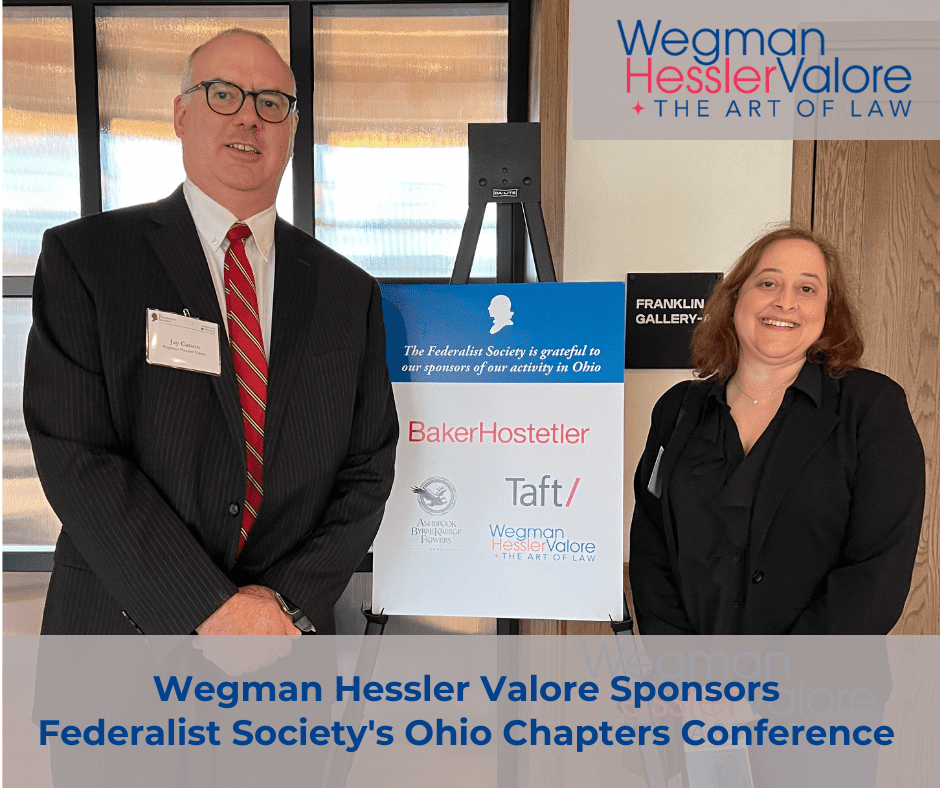
Wegman Hessler Valore Sponsors Federalist Society’s 2025 Ohio Chapters Conference
Columbus, Ohio – Wegman Hessler Valore proudly participated in the Federalist Society’s Ohio Annual Chapters Conference on April 4, 2025, with the firm’s litigation practice lead Angela Lavin and litigation…
AstraZeneca found liable for wrongful termination of worker in COVID-19 vaccine exemption claim in Federal Court
Cleveland – On November 26, 2024, a U.S. District Judge Pamela A. Barker of the Northern District of Ohio ruled that AstraZeneca discriminated against former employee Jonathan Bobnar when it…